Mathis Gatelier – Researcher in History / Intern at AVG-Carhif
During an internship at AVG-Carhif, I got the opportunity to process and inventory the EWMD archival collection. Behind this mysterious acronym lies the European Women’s Management Development Network. As its name suggests, the EWMD is a network aimed at promoting women’s access to decision-making positions in corporations. Still active today, this network emerged from a working group on gendered segregation in managerial careers within the European Foundation for Management Development Network (EFMD). Quickly becoming an independent organization, the EWMD established a central secretariat in Brussels which was for a time located at the Amazone House, thus explaining the presence of this collection at AVG-Carhif.
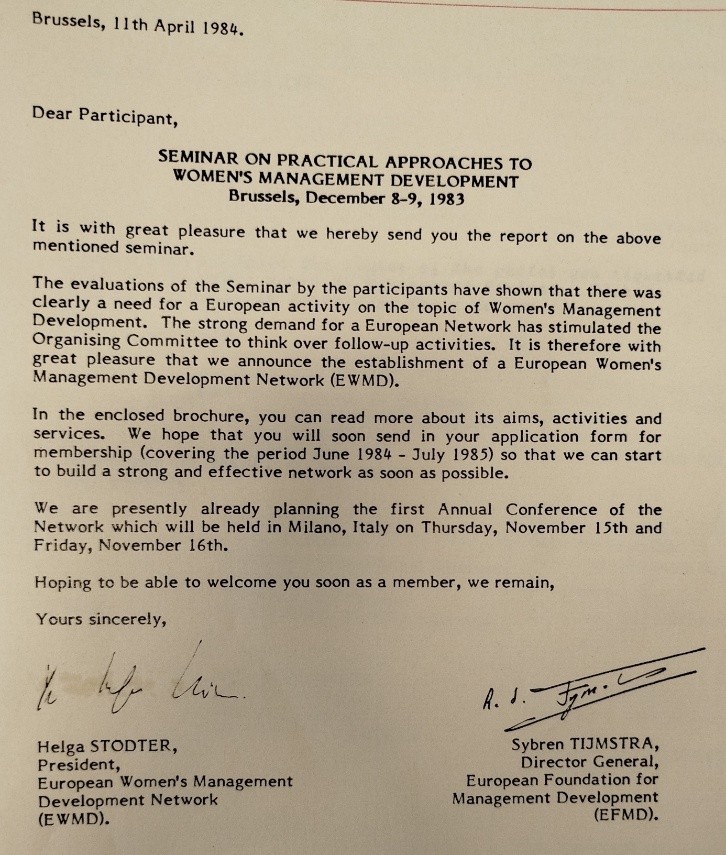
While this collection raises interesting archival challenges, particularly due to the decentralized nature of the network, its main interest lies in what it reveals about different ways of thinking gender equality in the corporate world. Starting from an explicit critique of the « glass ceiling », this network thinks of itself as a space for the circulation of knowledge produced by research, particularly in the then emerging field of gender studies. With members participating in academic conferences and maintaining ties with scholars in the sociology of work, the EWMD initially presented itself as a space for collective analysis of the structural inequalities running through managerial professions.
However, a shift quickly occurred. Participants, most of whom were women holding middle- or upper-management positions, called for conferences to be less theoretical and more directly oriented toward practical contributions to their professional lives. Conference content gradually turned toward management techniques, coaching, and narratives of individual success framed as personal development stories. The network’s communication increasingly emphasized training opportunities and networking in order to attract participants. The EWMD thus came to see itself less as a collective space of critical reflection than as a networking platform connecting managers.
This shift in objectives went hand in hand with a transformation of the feminist scope itself. While gender remained central to the network and its communication, it was no longer approached primarly through a critical analysis of power relations. Instead, it was staged through the promotion of exemplary female careers and bold entrepreneurial projects. This neoliberal feminism is centered on the idea of individual successs made possible by free competition between women and men, and is therefore relatively insensitive to other forms of exploitation or inequalities, like economic ones. This orientation is linked to the social positioning of EWMD members, who all hold positions of responsibility and evolve in space of power. The network is progressively caught up by a corporatist logic, in which the promotion of management took more space than the critique of gendered social relations. The functioned as the “women’s branch” of the EFMD, where the critique of gender relations was cleared out or at least softened. Some conference interventions even downplay, or outright deny, structural gender inequalities in order to support a meritocratic discourse.
Should this shift in the analytical framework be seen as a failure of the EWMD ? Not necessarily. From its earliest conferences, the network was conceived, under the influence of EFMD, as a space for the development of managerial skills. It was therefore unlikely that a lasting radical critique of workplace power structures would emerge within it. The initial attempt to make the EWMD a space for analyzing structural inequalities can be seen as an ambitious paradigm shift, but difficult to conciliate with the network’s institutional logics.
Rather than viewing this moment as a definitively closed parenthesis, this tension can be interpreted as reflecting a broader oscillation at work within individuals themselves. EWMD participants, whose sincere interest in gender equality is not in doubt, find themselves at the intersection of two logics: that of a neoliberal feminism compatible with managerial norms, and that of a more critical attention to deep socio-economic inequalities. The EWMD collection reveals a space in which feminist perspectives are constantly put in tension between corporatist logics and aspirations toward forms of emancipation that go beyond individual success.
Discover the archive of the European Women’s Management Development Network (EWMD) in our collections.