
In 2025, AVG-Carhif celebrated its 30th anniversary. To mark the occasion, we posted a monthly favourite from the team (and more) on our social media.
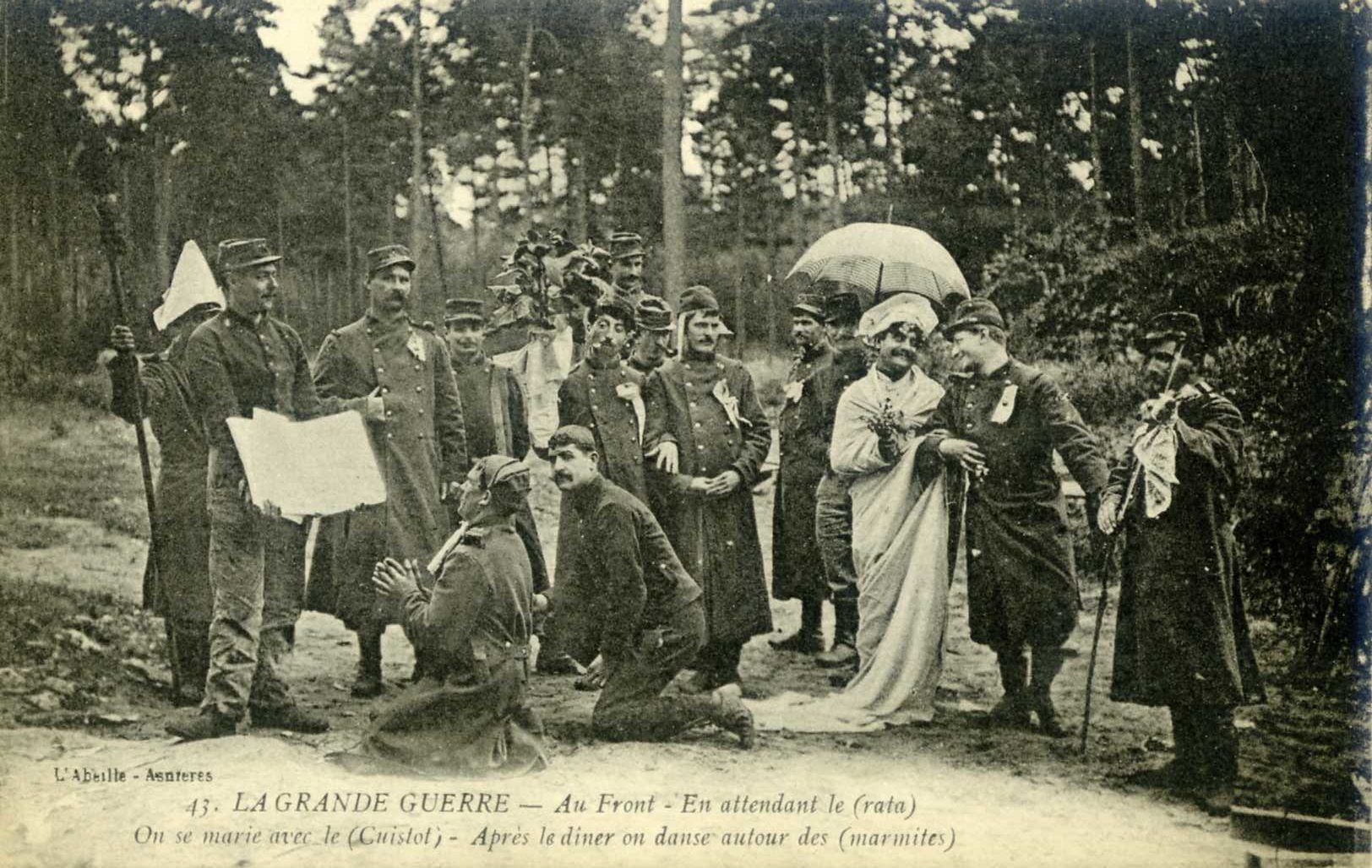
In this video, Henk De Smaele, gender historian at the University of Antwerp and co-chair of the AVG, presents his favourite: a postcard dating from the First World War depicting a mock marriage between soldiers.
English translation of the video
Henk De Smaele: I am Henk De Smaele. I am a historian. I am affiliated with the University of Antwerp, where I teach gender history and history of sexuality, among other subjects. I have also been co-chair of the Archive Centre for Women’s History here for fifteen years.
AVG-Carhif: What is your favourite item in our collection?
Henk De Smaele: It’s difficult to choose, but nevertheless, my choice is a postcard from the First World War. It’s actually a French postcard showing a kind of marriage between soldiers.
AVG-Carhif: Can you tell us a little more about it?
Henk De Smaele: So it’s actually something that happened a lot. During the First World War, all kinds of postcards were printed that soldiers could send to their families. And in this case, there are whole series of them, it’s actually a kind of fascinating image, and we don’t have very many of them where you can actually see how soldiers organise a kind of mock marriage. So they were actually pretending to get married. All the men in the photo are soldiers. But they were actually getting married. Among other things, it is said that soldiers in Belgium often lived as married couples. So one was called the husband, the other the wife. And children were adopted as uncles and aunts. So that group of soldiers, all men together in the barracks and at the front, actually organised a kind of marriage or a kind of family life with men and women.
AVG-Carhif: Why is it so important to you?
Henk De Smaele: What really interests me in a way is how, even in a context where there are only men, you still see a kind of femininity. And you notice in the letters that those soldiers wrote that they are actually very preoccupied with women and their wives and their mothers, and so on. So women and femininity are actually very important in that world of men. To the extent that they actually begin to embody that femininity themselves. That they actually take the step towards cross-dressing. That they actually begin to take on female roles themselves in a certain way. Of course, this happens in a way that is partly gender stereotypical. It also happens with a lot of laughter and a lot of burlesque and carnivalesque situations. Nevertheless, you can see very clearly that these men are taking on certain caring roles for each other. In a way, they also want to interact with each other in a feminine way. And as a gender historian, I find that a very interesting phenomenon.